Gold Just Crashed 8%: Why It Happened and Should You Still Buy?
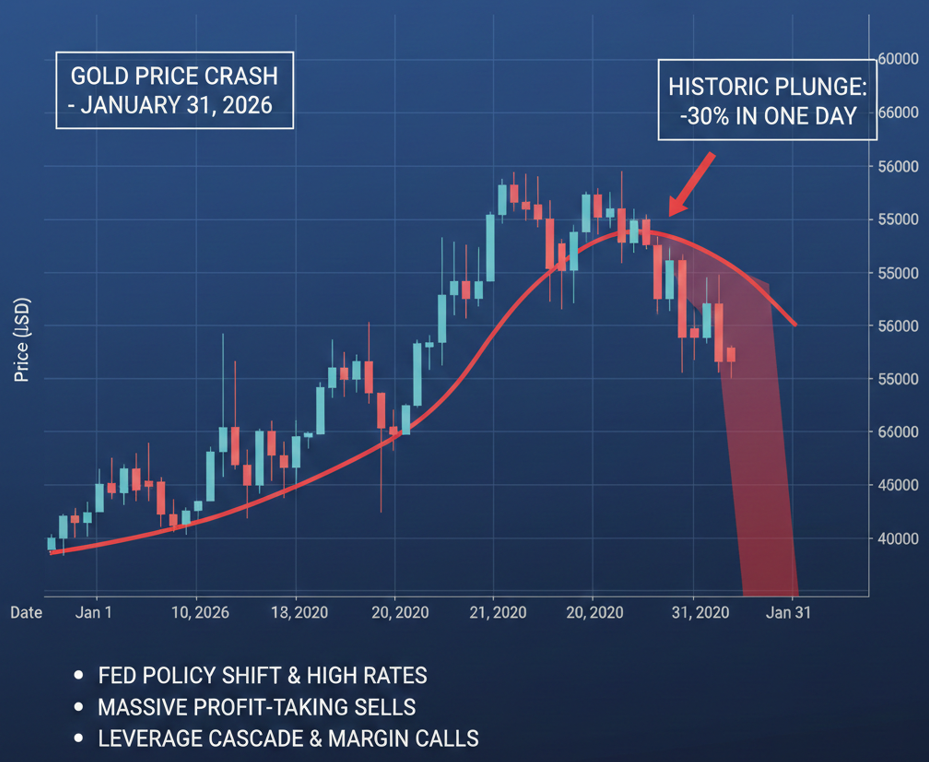
On January 31, 2026, gold suffered its sharpest single-day drop in 13 years, falling 8% from its $5,600 all-time high to test the $4,941 level. The yellow metal that gained over 50% in 2025 is now facing intense selling pressure. Is this the end of the bull run, or a rare buying opportunity?
If you're holding gold ETFs, physical bullion, or considering your first purchase, this volatility is unsettling. But before you panic-sell or rush to buy the dip, you need to understand what triggered this crash—and more importantly, where gold goes from here.
The Anatomy of the Crash: Three Forces Behind the Drop
1. The Fed's Hawkish Turn (Macro Pressure)
The most significant catalyst is the shift in Federal Reserve expectations. After months of anticipated rate cuts, recent economic data suggests the Fed may maintain—or even increase—interest rates longer than expected.
Why this matters: Gold doesn't yield interest. When rates rise, Treasury bonds become more attractive relative to the non-yielding metal. The Dollar Index (DXY) has surged to a three-month high, making gold more expensive for international buyers and triggering liquidations across emerging markets.
> "The 2025 gold rally was driven largely by FOMO (fear of missing out)," notes Capital Economics. "With the Fed unlikely to pivot dovish soon, we see gold falling to $3,500 by end of 2026—a 12% drop from current levels."
2. Technical Cascade: When Algorithms Sell
Gold had risen for seven consecutive sessions before the crash, pushing into extreme overbought territory (RSI > 85). The moment prices broke below $5,400, automated stop-loss orders triggered a cascading effect.
- Leveraged positions unwound: Traders using margin were forced to liquidate, accelerating the decline.
- Key support failed: The $5,000 psychological level is now the battleground. If it breaks, technical selling could push gold to $4,550 (the 50-day exponential moving average).
This wasn't fundamentally-driven selling—it was mechanical. Machines sold because other machines were selling.
3. Geopolitical Thaw (Reduced Safe-Haven Demand)
Gold's 2025 surge was partly fueled by conflict premiums: wars in Eastern Europe, Middle East tensions, and trade wars. Recent diplomatic signals—including potential US-China trade agreements and de-escalation rhetoric—have reduced the "fear trade."
However, this driver is fragile. Geopolitical risk doesn't disappear; it merely hibernates. UBS analysts argue that "political risks remain elevated" and any renewed conflict could quickly reverse the safe-haven outflows.
Is Now a Good Time to Buy Gold? A Strategic Framework
The answer depends on your time horizon and risk tolerance. Here's how different investors should approach the current $5,090 price level:
For Long-Term Wealth Builders (3-10 Years)
Verdict: Accumulate on weakness
Despite short-term pain, the structural bull case remains intact:
- Central bank buying continues unabated (Poland, China, Turkey added record reserves in Q4 2025)
- De-dollarization trends favor gold as reserve diversification
- ETF inflows remained robust throughout January's selloff, suggesting institutional "smart money" isn't fleeing
Strategy: Dollar-Cost Averaging (DCA)
Don't try to catch the falling knife. Instead, establish a programmed buying schedule:
- Invest 1-2% of your portfolio monthly over the next 6 months
- Target entry zones: $4,950 (current), $4,550 (if 50 EMA breaks), $4,360 (major support)
- Allocation suggestion: 5-10% of total portfolio in gold (up to 15% if you're particularly bearish on fiat currencies)
For Short-Term Traders (1-6 Months)
Verdict: High risk, selective opportunities
The technical picture offers a clear risk/reward setup:
- Bull case: If $5,000 holds, expect a bounce to $5,400-$5,450 resistance. Consider long positions with tight stops at $4,950.
- Bear case: A break below $4,900 opens the door to $4,550. If you're short, that's your next target.
Warning: Volatility is extreme. Use position sizing—risk no more than 2% of capital on gold trades.
For First-Time Buyers
Verdict: Wait for stabilization
If you don't own gold yet, this volatility isn't your friend. Wait for:
- 3 consecutive days of price stability (signaling a base)
- RSI to fall below 70 (removing overbought conditions)
- Clarity on the next Fed meeting (March 2026)
Actionable Checklist: What to Do This Week
If you currently hold gold:
- [ ] Review allocation: Is gold more than 15% of your portfolio? If yes, trim on rallies to $5,200+ to rebalance.
- [ ] Check storage costs: If holding physical, ensure you're not paying high premiums; if holding ETFs like GLD/IAU, verify expense ratios (should be <0.40%).
- [ ] Set alerts: Configure price alerts at $4,900 (add) and $5,400 (trim).
If you're looking to buy:
- [ ] Start small: Don't deploy all capital at once. Begin with 25% of your intended allocation at current prices ($5,000-$5,100).
- [ ] Choose format wisely:
- Physical coins/bars for disaster insurance (keep <5% of gold allocation in physical)
- ETFs (GLD, IAU) for liquidity and ease of rebalancing
- Avoid futures/CFDs unless you're a professional trader
- [ ] Automate: Set up automatic monthly purchases to remove emotion from the process.
Avoid these mistakes:
- ❌ Trying to time the exact bottom (impossible)
- ❌ Selling out of fear if gold falls to $4,550 (that's likely the buy zone)
- ❌ Buying mining stocks (GDX) instead of physical/ETFs—they're underperforming gold due to rising energy costs
The Institutional Divide: Where Do the Banks Stand?
| Institution | 2026 Target | Rationale |
|---|---|---|
| Goldman Sachs | $4,900 | Structural buying from wealth funds; central bank demand persists |
| UBS | $4,200 | Political risks premium; upside scenario to $4,700 if tensions flare |
| HSBC | $3,800 | Peak buying cycle ends; weak jewelry demand at high prices |
| Capital Economics | $3,500 | Extreme overvaluation; Fed hawkishness persists |
The takeaway: Even the most bearish forecast ($3,500) implies gold remains 30% higher than where it started 2025. This isn't a bubble bursting—it's a healthy correction in a secular bull market.
Final Verdict: Patience Over Prediction
Gold's 8% crash was violent but necessary. Markets that rise 50% in one year should correct by 10-15%. The question isn't whether gold will recover—it's whether you can stomach the volatility until it does.
My recommendation:
- Hold existing positions through this turbulence. You didn't buy gold for tomorrow's price; you bought it for next decade's uncertainty.
- Buy incrementally if gold breaks below $5,000, targeting $4,550 as your "full allocation" entry point.
- Ignore the daily noise. The US national debt just crossed $37 trillion. Central banks are printing currency to monetize deficits. These fundamentals haven't changed because gold dropped $500.
The 2025 gold bull market isn't dead. It's just catching its breath.
Disclaimer: This analysis is for educational purposes only. Precious metals are volatile and may not be suitable for all investors. Consult with a financial advisor before making investment decisions. Past performance does not guarantee future results.